Eukaryotic-Flagella-Cilia-Movement | Notes-by-UK-Sir | Cell-Bio-12
CELL (Flagella Cilia)
 |
| Eukaryotic-Flagella |
Want to Know about Ribosome, Peroxisome, Glyoxysome :
https://uksirnotes.blogspot.com/2021/07/Ribosome-Peroxisosomes-Glyoxysome-uksirnotes.html
Flagella
& Cilia
•
Fine
thread or Hair like structure.
•
Help
in Locomotion of the cell
•
Flagella-
longer 100-200μm,
1-4 per cell.
•
Cilia
– smaller 5-20 μm,
numerous in number.
•
Present
in –
Bacteria, Protists, motile algae, spermatozoa, gastro dermal
cell of coelenterate, zoospores, gametes thallophytes, larval bodies, Cilia in Respiratory
track, oviduct, kidney renal tubule etc.
Structure:
•
Both
have same structure.
i) Basal body / kinetosome
ii) Rootlets
iii)Basal plate
iv) Shaft
 |
| Eukaryotic-Flagella |
1.Basal body / kinetosome:
•
Also
called as basal granule or blepharoplasty.
•
Embedded
in outer part of the cytoplasm just below membrane.
•
Looks
like Micro cylinder just like centriole.
•
Protein
fibers are 9+3 condition, but without central axis.
2. Rootlets
•
Straight
out growth from lower part of the basal body.
•
Provide
support to basal body.
•
Bundle
of micro fibrils present in cytoplasm.
3. Basal plate
•
Dense
area, present above the basal body.
•
Present
at the level of plasma membrane.
•
Central fibril develops from this area.
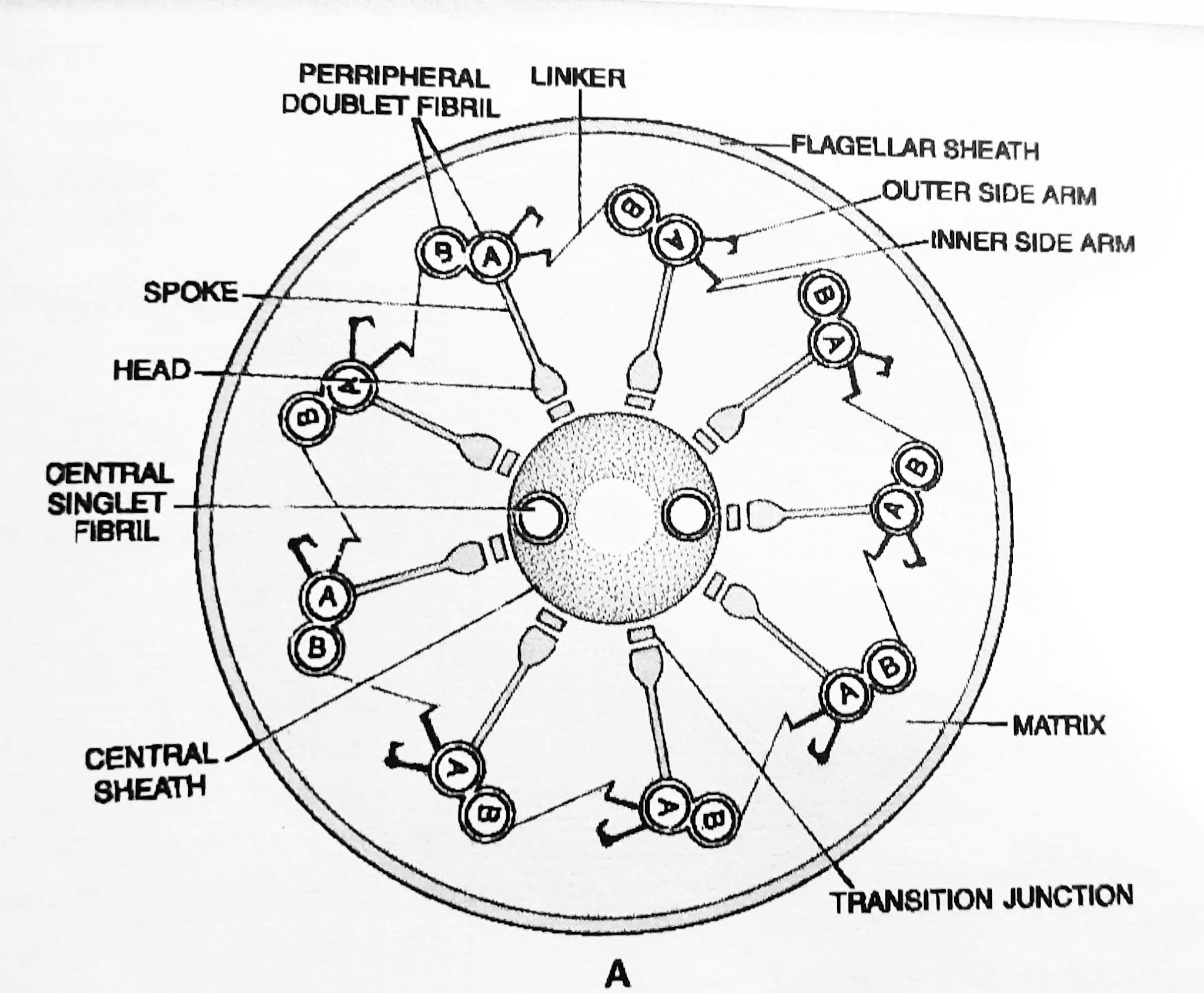 |
| Flagella structure |
4. Shaft
•
This
is Hair like projection.
•
Length
5-20 μm in cilium and
100-200 μm
in flagella.
•
It
contain a semi fluid matrix and Central fibers – axoneme
•
Show
arrangement of 9+2 configuration or 11 stranded.
•
Central
2 singlet covered by protein sheath.
•
Peripheral
fibril consists of 2 microtubule or sub fiber (B and A).
•
2 bundles connected by linker- nexin protein
present.
•
Sub
fiber contains hook – made by dynein protein- also show ATPase activity.
•
The
Central fiber – made by tubulin protein.
•
Centre
connects with Peripheral bundles by - radial projection/ spoke.
Flagella may be of two types-
 |
| Type of Flagella |
•
Whiplash
type- smooth surface.
• Tinsel type – hairy surface.
Movement-
 |
| Movement |
•
Flagella-
undulatory movement (wavy movement), from base to tip or reverse.
•
Occurs
with a power stroke and a return/recovery stroke.
•
Normally
10-40 strokes /sec occur.
•
Cilia
: show rowing type or sweeping movement.
•
May
be all cilia simultaneously- iso-chronic
or synchronous.
•
May
be One after another – meta chronic.
•
In
Paramecium – speed is 1500 μm / 12 cell length/ sec.
Function
•
Main
function is Locomotion in unicellular case.
•
Help
in food circulation and also help to capture food.
•
Create
water current for gas exchange.
•
In
Respiratory track- eliminate dust particles.
•
Cilia
help in Internal transport-during passage of sperm in oviduct.
•
In
kidney can help in absorption.
•
Act
as Sensory organ- in protoplasmic structure. (can sense to – light, temp,
contact)
•
Help
in conjugation and gamete fusion.
Want to Know about Ribosome, Peroxisome, Glyoxysome :
https://uksirnotes.blogspot.com/2021/07/Ribosome-Peroxisosomes-Glyoxysome-uksirnotes.html


Wonderful and awesome notes.... Nice
ReplyDeleteThanks for your interest.. keep going
Delete